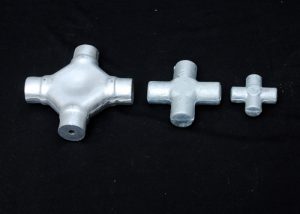
Machined parts provide various advantages, including high precision, outstanding dimensional accuracy, consistent quality, and a superior surface polish. They can be made from a variety of materials a...
CNC turning parts provide various advantages, including high precision, outstanding dimensional accuracy, consistent quality, quick manufacturing, and minimal material waste. They can manufacture comp...
Turned parts are machine components created by removing material from a spinning workpiece with a cutting tool on a lathe or CNC turning machine. They are typically cylindrical or circular in shape an...
The turning parts idea refers to a manufacturing method in which a workpiece is rotated about its axis while a cutting tool removes undesirable material to create the desired shape. It is mostly condu...
A forged nut is a mechanical fastener that attaches two or more components by tightening it on a threaded bolt or stud. It is made by the forging process, which offers it greater strength, hardness, a...
Nut forging is the process of producing nuts by shaping hot metal under high pressure with forging dies. In comparison to machining from solid material, this method increases the nut's strength, h...
Head forging is the process of applying compressive force to a heated metal blank to generate the desired head form and dimensions of a component, such as a bolt, rivet, or fastener. It increases the ...
Upset forging provides several advantages, including increased strength, toughness, grain structure, and dimensional accuracy. It is often used to make components like shafts, bolts, gears, and flange...
Leaf spring parts are often made of high-carbon spring steel, which gives excellent strength, hardness, elasticity, and resistance to repeated bending. Common materials include silicon-manganese steel...